





Booking a professional recording studio for the first time feels bigger than it should. There’s an idea that you need to know everything before you arrive, that walking in underprepared will somehow expose you as someone who doesn’t belong there.
That’s not how it works. But going in with a clear sense of what to expect, what to prepare, and how to make the most of your time will make a real difference to what you walk out with.
Here’s what you actually need to know.
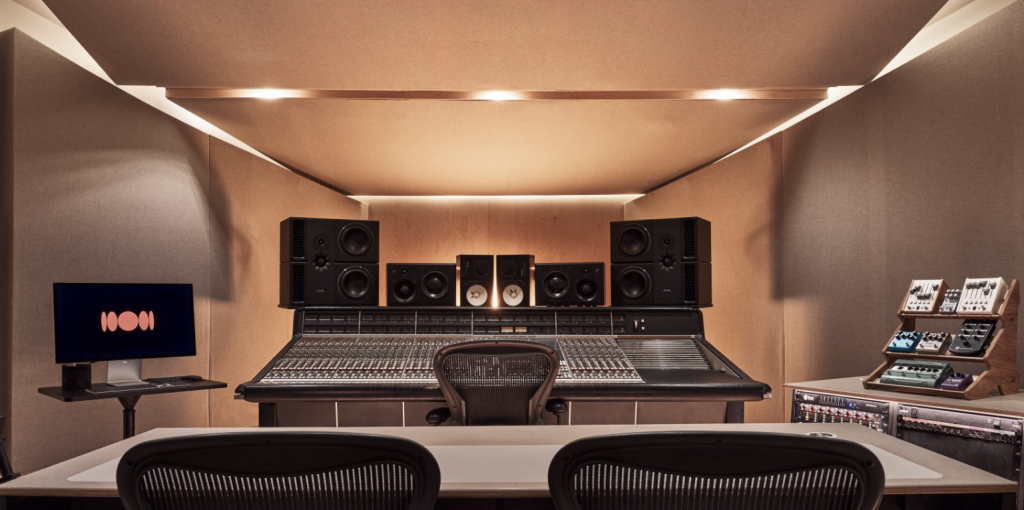
Day hire studios vary considerably. The most important distinction is between a room that’s an acoustically treated recording space with professional signal chain and one that’s essentially a production suite with good monitors. Both are useful but for different things.
At Ten87 Studios – a community of over 60 professional studios in Tottenham, north London – our day hire options are The Club and Studio B. The Club is a large-format live recording space built for bands, vocalists, and sessions that need room. Studio B is a production and recording suite with a comprehensive outboard rack, suited to producers, beatmakers, and artists working in more self-contained setups. Knowing which space you’re in before you arrive shapes how you prepare.
When comparing studios, look specifically at:
Have your session file organised. If you’re bringing a project from home – Ableton, Logic, Pro Tools, whatever your DAW – export stems of everything. Bounce all your tracks individually, properly labelled, at the same sample rate and bit depth. Keep the original project file too. Nothing wastes session time faster than untangling an unfamiliar project on someone else’s hardware.
Know your key sounds and patches. If you’re using specific software synths or plugins, either install them on the studio machine beforehand (check what the studio has installed and what you’d need to bring on a drive) or export frozen/rendered versions of those tracks. Don’t arrive expecting the studio to have your preferred version of every plugin.
Prepare a simple brief. This is more useful than it sounds. Write down – even just for yourself – what you want to walk out with. Three finished vocal takes? A rough mix of four tracks? A fully produced instrumental? Being clear about the goal before you arrive stops you from drifting mid-session. If you’re working with an engineer, a brief lets them support you properly.
Do a gear check the night before. If you’re bringing hardware – a synth, a guitar, pedals, an audio interface as a backup – test it the night before. Check your cables. Bring spares. The session is not the moment to discover something isn’t working.
Day hire typically runs in blocks – half-day or full day. Here’s what makes the difference between a session that delivers and one that runs out of time before it gets anywhere useful.
Start with a quick sound check, not a full take. The first thing you should do in any unfamiliar room is listen. Play something you know well through the monitors. Record a short test take if you’re going to be recording. You’re calibrating your ears to the room, not committing to anything yet.
Work in order of importance. Whatever absolutely has to come out of the session – do that first, while your energy and focus are fresh. Save the nice-to-haves for the end. Sessions almost always compress toward the finish; you want what matters done before that happens.
Don’t overthink the environment. The room, the equipment, the professional setting – these are working for you, not against you. Some first-timers get self-conscious and perform worse than they would at home. The room is acoustically designed to make you sound good. Trust that and work.
Take a break. Ear fatigue is real. If you’re mixing or monitoring for more than 90 minutes without a break, your judgement starts to go. Step out, get a coffee, come back to it. A ten-minute break returns you to a session sharper than you left it.
Before you leave, make sure you have:
If you’re heading to mixing and mastering after, export stems organised clearly by instrument group. The engineer you work with will thank you for it and you’ll get better results.
Both our day hire spaces – The Club and Studio B – come with access to professional-grade monitoring and a comprehensive gear setup. Studio B is fully self-operated with a detailed guide available, and both spaces are part of a working studio community rather than an anonymous booking facility.
If it’s your first session and you’d like to talk through what would work best for your project before booking, get in touch with us directly. Otherwise you can review what’s available and check dates on the day hire pages.
The first professional session is the one that shows you what’s possible. The ones after that get easier.
There’s no avoiding the conversation right now. Every producer forum, every music tech newsletter, every panel at every conference is asking the same question: what does AI actually mean for the recording studio?
At Ten87 Studios – a community of over 60 professional studios in Tottenham – we hear it constantly from our members and day hire artists. Some are excited. Some are sceptical. Most are somewhere in between: curious enough to try things, experienced enough to know when something isn’t quite right.
So here’s an honest take. Not a sales pitch for any particular tool, and not a dismissal of something that genuinely is changing the way people work.
Stem separation
This one has quietly become indispensable. Tools like Meta’s Demucs – which splits a mixed track into vocals, drums, bass, and everything else – used to produce results that were clearly artefacted. Now they’re clean enough to use in a professional context.
In practice, producers at Ten87 Studios use stem separation for: sampling and interpolation without legal headaches, learning a mix by isolating elements, and rescuing old recordings where the original sessions no longer exist. It’s one of those tools that saves hours and asks for nothing in return except a decent export.
AI-assisted mixing and mastering
iZotope’s Ozone, Sonible’s smart:comp, Waves’ AI-powered plugins – these have genuinely improved. The useful framing here is not “will AI mix my track for me?” but “can AI handle the analytical groundwork so I can focus on the creative decisions?”
The answer, increasingly, is yes. Loudness matching, frequency balance checking, basic dynamic control – these are tasks where the machine is fast and accurate. Where human ears still win is in the judgement calls: the choice that makes a mix feel like something, not just measured correctly.
Platforms like LANDR have also made rapid strides on mastering turnaround. For an independent artist who needs a competent master at speed, it’s a real option. For an artist who wants a master that stands out, there’s still no substitute for working with an experienced engineer in a calibrated room – which is exactly what our mixing and mastering suite at Ten87 Studios is built for.
Arrangement and composition assistance
More contested, but genuinely useful for the right workflow. If you have a strong melodic or harmonic idea but blank out on arrangement, tools that suggest chord variations or fill out instrumentation can break a creative block. The key distinction – one most working producers will instinctively understand – is using the suggestion as a starting point, not a finished answer.
Noise reduction and restoration
Probably the clearest win. AI-powered noise reduction (iZotope RX being the benchmark) has reached a level where recordings that would previously have been unusable can now be salvaged. Room noise, mic handling, background hum – treated non-destructively and with a quality that simply wasn’t possible five years ago.
Fully generative song creation
Suno, Udio, and their peers are genuinely impressive as demonstrations. As professional tools, they’re more limited than the headlines suggest. The issue isn’t technical – it’s creative. Output tends toward the generic because the models are trained on the aggregate of what already exists, not on taste or intention.
There’s also the question of ownership, ethics, and the music industry’s ongoing reckoning with how these models were trained. These aren’t settled questions, and for working artists, that uncertainty is real. A significant number of producers surveyed by Sound on Sound in early 2026 cited ethical concerns as a reason to hold back from generative tools specifically.
AI as a replacement for a proper acoustic environment
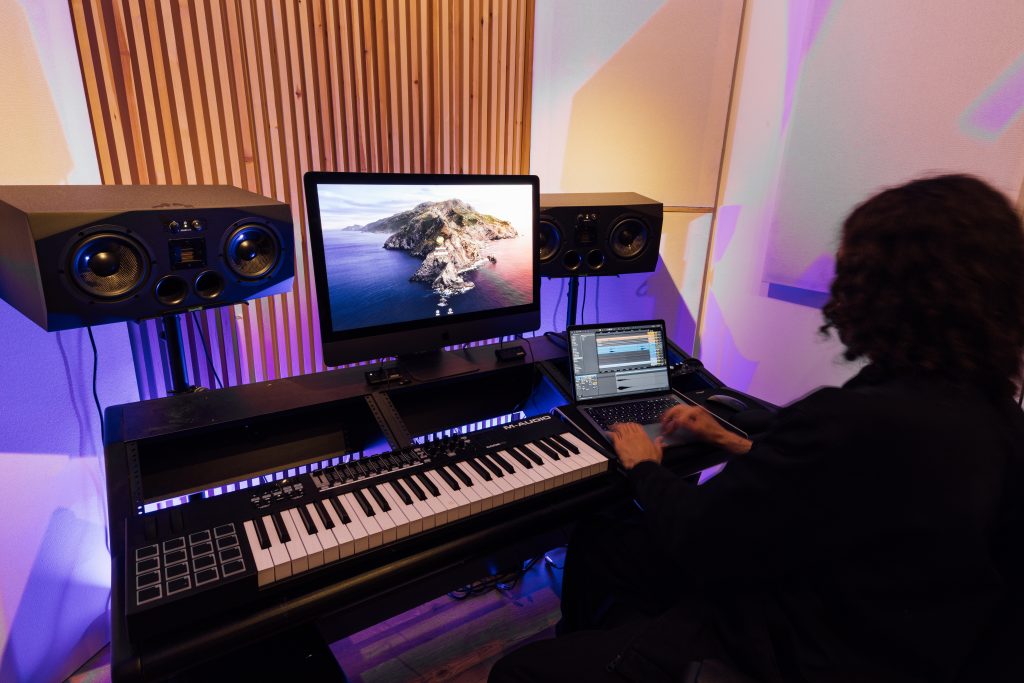
No plugin corrects a bad room. No algorithm compensates for a mic placed wrong, monitors that aren’t calibrated, or a performance captured through a compromised signal chain. The ceiling for what AI can fix in post is much lower than the marketing implies.
This is where a dedicated professional space matters more than ever. When the source material is right, AI tools are powerful. When it isn’t, they’re limited.
The 2026 Sonarworks survey of over 1,100 working producers found the majority treat AI as a selective, task-specific tool – useful for audio cleanup, stem separation, and technical analysis, but kept away from the core creative decisions. The language that came up repeatedly was “assistant, not replacement.”
That tracks with what we see at Ten87 Studios. The producers who are thriving with these tools aren’t the ones who have handed over creative decisions. They’re the ones who’ve identified the parts of the process they found tedious or slow and have found specific tools to handle them – while keeping the things that actually make music interesting firmly in their own hands.
AI is a real and permanent part of music production in 2026. It’s not a fad, but it’s also not the revolution some of the coverage suggests. The most useful framing is: it’s a set of genuinely powerful tools for specific tasks, and like any tool in the studio, the quality of the output depends entirely on the skill of the person using it.
At Ten87 Studios, our members have access to professional hardware, calibrated rooms, and experienced engineers – the foundation that makes any production approach, AI-assisted or not, actually work.
If you want to book a day hire session and bring whatever workflow suits you, find out more here. If you’re interested in what our mixing and mastering team can do, take a look at our services.